Faulting & Geologic Formations
Death Valley National Park is one of the most geologically dynamic landscapes in North America. Its present form is primarily the result of faulting, a process that has shaped both the towering mountain ranges and the deep desert basins that define the region today.FAULTING
Faulting is the fundamental geologic force responsible for the existence of Death Valley. The park lies within the southwestern portion of the Basin and Range Province, a vast region characterized by alternating mountain ranges and valleys formed through crustal extension. In this setting, large blocks of the Earths crust are broken by faults, then uplifted or dropped downward. The uplifted blocks form mountain ranges, while the down-dropped blocks create valleys such as Death Valley.Most modern faulting in the region is strike-slip in nature, meaning the land on either side of a fault moves horizontally past one another. However, this motion is often combined with normal faulting, in which one block drops relative to another due to crustal stretching. This combination reflects the complex tectonic forces acting on the area.
Fault movement also produces earthquakes. While most seismic activity in Death Valley today consists of small, barely noticeable events, the presence of major fault systems indicates the potential for a larger earthquake in the future. The timing of such an event cannot be predicted, but ongoing tectonic stress makes it inevitable over geologic time.
GEOLOGIC FORMATIONS
Death Valley National Park is internationally recognized for its exceptional geologic diversity and well-preserved rock record. The park was established in part to protect these features, which provide insight into nearly the entire span of geologic time.Some of the oldest rocks in the park, found in the Black Mountains, are metamorphic formations approximately 1.8 billion years old. These ancient rocks record early episodes of crustal formation and transformation. In contrast, the valley floors contain much younger sediments, including playa deposits that continue to accumulate in modern times.
This wide range of rock types and ages makes Death Valley a valuable natural archive of Earth history. Equally important is the fact that geologic processes remain active. Wind erosion, periodic flooding, sediment deposition, and tectonic movement continue to reshape the landscape. Death Valley is not simply a relic of the past, but an evolving system where geologic change can still be observed in real time.
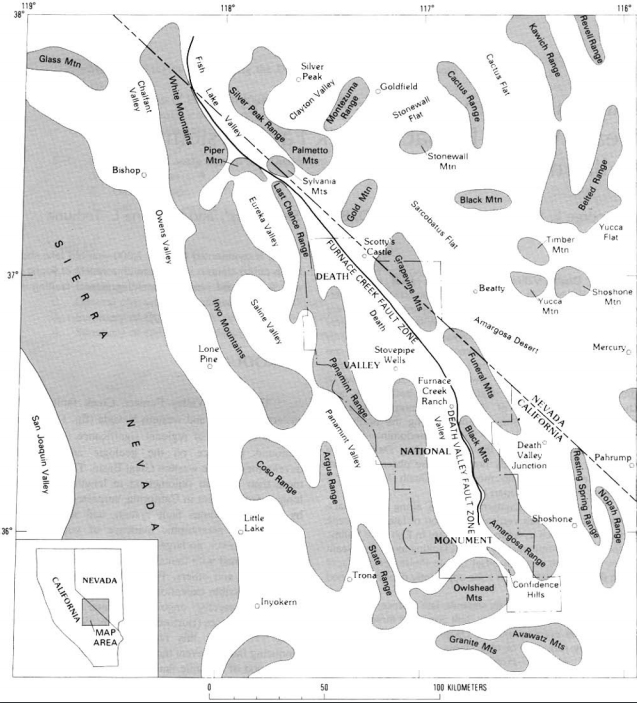
Fault Zone Map - click for larger map
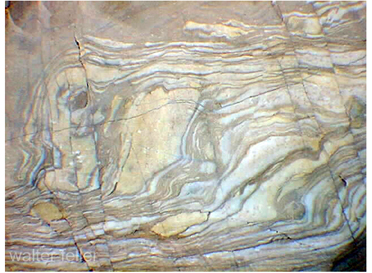
Mosaic Canyon