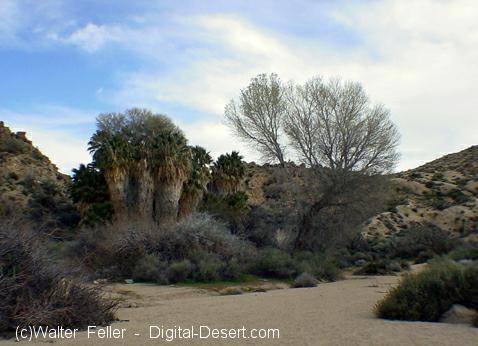
California Fan Palm Oases
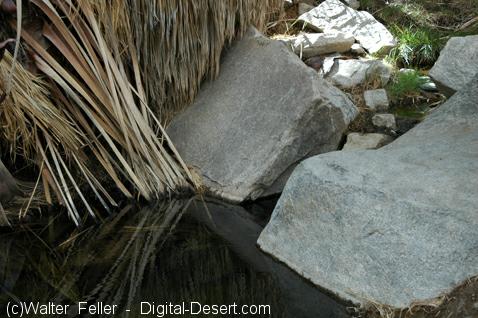
In an otherwise hot and spare desert, a palm oasis feels like a small luxury. Shade, cooler air, and the sound of water all come together because of one simple requirement: a steady supply of groundwater forced to the surface. Faults and fractured bedrock bring that water up, and where it reaches daylight, palms take hold. There are about 158 desert fan palm oases in North America, with five in Joshua Tree National Park.Washingtonia filifera, the desert fan palm, is native to the low, hot deserts of California. A mature tree can reach seventy-five feet and live eighty to ninety years. It is also the heaviest North American palm, weighing as much as three tons. The leaves are broad fans, nearly six feet across, and when they die they stay attached, forming the familiar skirt unless wind, water, or fire removes them.
People have relied on palm oases since prehistoric times. Serrano and Cahuilla families burned the leaf skirts to open the ground, increase fruit yield, and clear sharp fronds from footpaths. They used the leaves for weatherproof shelter and ate the fruit. They also planted seeds at spots where water seemed promising, enlarging or establishing groves.
Desert fan palms require ready groundwater. They draw moisture through dense mats of pencil-sized rootlets extending roughly twenty feet from the trunk. This thick root mat excludes other plants but is easily torn away in flash floods. In tight canyons, floods often kill palms outright, leaving only scattered survivors on higher benches.
Palm oases stand tall and straight, a welcome sight in a dry country. They support many forms of life, and although they look sturdy, they are easily damaged. Visitors do well to move through them with care.
Lost Palms Oasis
49 Palms Oasis
Oasis of Mara
Cottonwood Springs
Also see:Desert Habitats
Waterholes, Springs & Oases
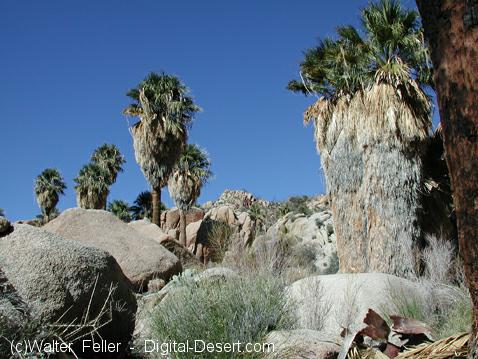
The surface water at an oasis will attract animals such as bighorn sheep, Gambel's quail, and coyotes. Coyotes will eat the fruit and deposit the undigested seeds in other areas, if there is enough water they will grow. Western yellow bat will only live in fan palm trees. Barn owls will also make their home in the giant leaves. Hooded oriole may also make thier woven sack nests under the leaves. Holes in the tree trunk are made by the blue-black, giant palm-boring beetle, Dinapate wrightii. These beetles live exclusively in fan palms.