The Contact Zone
It's our tendency to view the Earth as unchanging and static. But here engraved upon the face of this mountain rock is a story of change. The dark mountain rock is Pinto gniess (pronounced nice). The lighter color rock is granite- monzogranite. The granite crystallized from magma deep within the Earth, which forced its way into the gneiss 85 million years ago. Here, where the two rocks touch, marks the edge of the magma chamber- the contact zone.The granite, over millions of years, broke through the surface of the ground by mountain uplifting, underground chemical weathering, and finally, surface erosion. Now exposed, the granite reveals to us eons of geologic story.
Surface erosion exposed the already deeply weathered granite. During an earlier, wetter climate, the valley was cut by the action of flowing water. A stream knifed through the overlaying gniess, widening it and flushing the sediments away. Today, with a dryer climate and no stream to carry debris away, sediments are deposited and remain in the valley.
Previous - Next
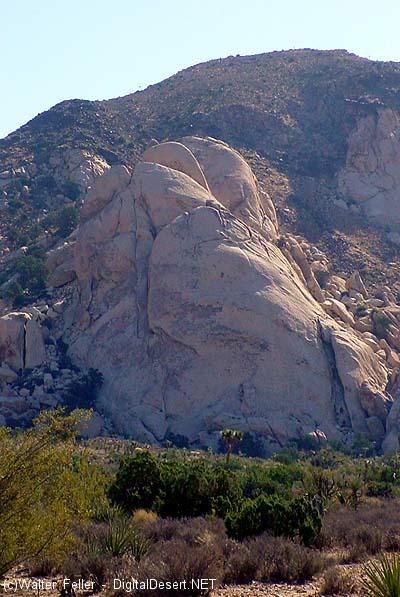
The contact zone<
| Intro:: Nature:: Geography & Maps:: Parks & Preserves:: Points of Interest:: Ghosts & Gold:: Communities:: Roads & Trails:: People & History:: Blog:: Weather:: |
|
Digital-Desert :
Mojave Desert
|
|
Country Life Realty Wrightwood, Ca. |
Mountain Hardware Wrightwood, Ca. |
Canyon Cartography |
G.A. Mercantile |
Grizzly Cafe Family Dining |
|
Abraxas Engineering privacy |
For educational use only; not a travel or safety guide. Copyright (c) Walter Feller, 1995-2026. All rights reserved. |