Death Valley's Lost 49ers
Among the many migration stories of the California Gold Rush of 1848-1855, few became as closely tied to the mythology of the American West as the ordeal of the Lost 49ers in Death Valley, California. Their journey combined misplaced optimism, poor geographic knowledge, winter hardship, and the brutal environment of the Great Basin and Mojave deserts. Though only part of the emigrant companies suffered the worst conditions, the episode became permanently connected with the naming and historical identity of Death Valley itself.The story began in 1849 after gold was discovered at Sutter's Mill near Coloma, California. Thousands of emigrants traveled west by wagon in hopes of finding fortune in the gold fields. One of the major outfitting points along the overland trails was Salt Lake City, Utah, where travelers repaired wagons, gathered supplies, and prepared for the difficult crossing ahead. Timing was critical because emigrants had to cross the Sierra Nevada before winter storms blocked the mountain passes. The disaster of the Donner Party only a few years earlier remained fresh in public memory and served as a warning of what could happen to wagon trains delayed too long in the mountains.
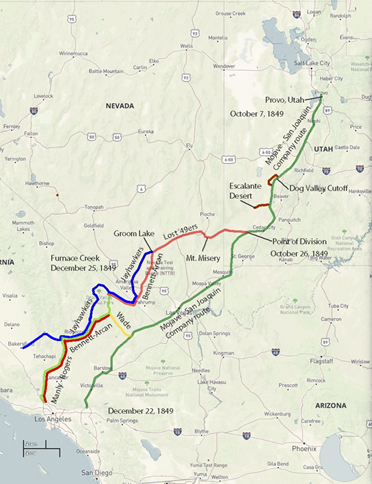
In October 1849 several emigrant companies arrived at Salt Lake City dangerously late in the season. Rather than risk snowbound passes in the Sierra Nevada, they became interested in the Old Spanish Trail, a southern route believed to avoid heavy winter snows. The wagon train originally traveled under the guidance of Jefferson Hunt, an experienced frontiersman familiar with the route. Hunt moved cautiously, however, traveling only as fast as the slowest wagons. Some emigrants became impatient and eager for a faster alternative.
Their opportunity appeared when a young traveler arrived carrying a map supposedly based on explorations by John C. Fremont. The map suggested a shortcut westward toward Walker Pass that promised to reduce the journey by hundreds of miles. Enticed by the possibility of reaching California more quickly, most of the emigrants abandoned Hunt's slower route and struck west into largely unmapped country near present-day Enterprise, Utah. This decision proved disastrous.
Almost immediately the emigrants encountered severe terrain at Beaver Dam Wash along the Utah-Nevada border. Steep canyon walls made wagon travel painfully slow and exhausting. Many families quickly lost confidence and returned to rejoin Hunt, but roughly twenty wagons continued onward despite mounting uncertainty. Matters became worse when the man carrying the shortcut map abandoned the group during the night, leaving them without either a reliable guide or accurate directions. Even so, the emigrants pressed westward, believing that persistence alone would eventually bring them to California.
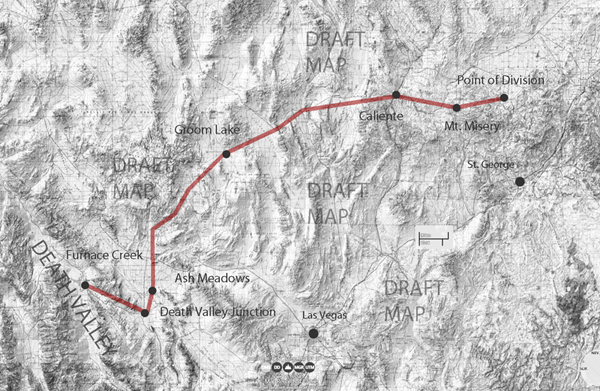
Over the following weeks the wagon companies wandered through remote portions of present-day Nevada, traveling through areas such as Panaca, Tikaboo Valley, and Groom Lake. Water became scarce, livestock weakened, and tempers frayed under the stress of desert travel. At Groom Lake disagreements over the route split the emigrants into separate parties. One group wished to follow Indian trails southward toward water sources, while the other insisted on continuing west. Ironically, both groups survived only because winter storms left snow and meltwater across the desert. Eventually they reunited near Ash Meadows east of Death Valley and continued toward the basin itself.
On Christmas Eve of 1849 the exhausted emigrants reached Travertine Springs near present-day Furnace Creek. By then they had spent nearly two months crossing harsh desert country since leaving the Old Spanish Trail. Their oxen were starving from lack of forage, wagons were badly damaged, and supplies had dwindled to dangerous levels. Before them rose the mountain walls surrounding Death Valley, which appeared impassable in every direction. Attempts to locate an escape route near present-day Stovepipe Wells failed. The emigrants finally accepted that their wagons had become a burden rather than a means of survival.
Near the dunes of Death Valley they dismantled wagons and burned the wood for cooking fires at a location later known as Burned Wagons Camp. Oxen were slaughtered for meat, much of which was dried into jerky for the difficult journey ahead. Leaving behind most of their possessions, the emigrants escaped the valley on foot by climbing westward over rugged passes into Panamint Valley. The terrain beyond proved scarcely easier. They crossed additional desert valleys and eventually entered the barren Mojave Desert Plateau, where water existed only in scattered puddles and patches of ice left by recent storms.
At last the survivors descended toward settlements near present-day Palmdale and Newhall, California, where Californio ranch workers from Rancho San Fernando helped rescue the starving emigrants. Although several deaths occurred during the larger journey, most of the party survived, an outcome remarkable considering the conditions they endured. According to later tradition, one woman turned to look back at the valley during their escape and exclaimed, "Goodbye, Death Valley." Whether entirely authentic or partly embellished over time, the phrase became permanently attached to the landscape.
The ordeal of the Lost 49ers remains central to the history of Death Valley because it illustrates the dangers of overconfidence and incomplete geographic knowledge during westward expansion. It also demonstrates how quickly emigrant optimism could collapse when confronted by the realities of the desert environment. What the emigrants experienced was not merely heat or isolation, but the combined pressures of thirst, hunger, exhaustion, rugged terrain, and uncertainty across one of the harshest landscapes in North America. Their suffering transformed an obscure desert basin into one of the most famous place names in the American West.
Source material from National Park Service history.
High Sierra Mountains Old Spanish Trail, Death Valley. Old Spanish Trail Captain Jefferson Hunt, John Fremont

Walker Pass. Jefferson Hunt,

Ash Meadows Death Valley Junction Highway 190. On Christmas Eve of 1849, the group arrived at Travertine Springs, Furnace Creek.
sand dunes Panamint Valley, Ridgecrest. Highway 178
Walker Pass, Mojave Desert Plateau. Palmdale, California
Death Valley in '49
William Lewis Manly
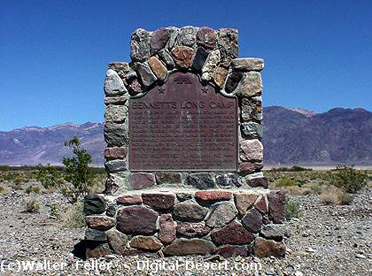
Monument at Bennett's Long Camp
Naming of Death Valley
...
Just as we were ready to leave and return to camp we took off our hats, and then overlooking the scene of so much trial, suffering and death spoke the thought uppermost saying:--"_Good bye Death Valley!"_ then faced away and made our steps toward camp. Even after this in speaking of this long and narrow valley over which we had crossed into its nearly central part, and on the edge of which the lone camp was made, for so many days, it was called Death Valley.
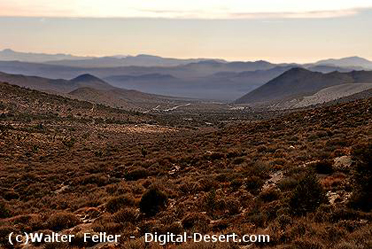
View toward Death Valley from the top of Walker Pass
"Ironically, they walked right by Walker Pass ..."
Manly and Rogers had to descend through the El Paso Mountains. Many believe they came through Last Chance Canyon to do so.